Featured

3 Great Reasons to Learn English

universal language, learn english, open new doors

  1. English is a Universal Language:

English is among the most widely spoken languages across the globe.  This means that wherever you go, especially in cities, you will likely be able to communicate with others in English.  Another bonus of knowing a universal language is that you can even enjoy a variety of other media such as songs, movies, books in their original language as well as articles, videos and other online media.  

Self-Development through learning English,
English music, English movies

2. Self-Development:   

What could be more satisfying than being proficient in a new language?  Learning English will will open up new opportunities and broaden your horizons. You’ll also be able access more materials and communicate with more people.

3. English is an International Business Language:

Besides being an incredibly useful skill, English is an International Business Language. Proficiency in English is an excellent feature on any resume!  Be assured that knowing English will certainly make you more employable. It is recommended to study business English as that will help you with specific vocabulary required in a business setting.

Learn English for Business purposes,
business English, business vocabulary

Should You Invest in an English Tutor for Your Child? Here’s How to Know

If you’ve ever wondered whether hiring an English tutor for your child is worth it, you’re not alone. Many parents notice their children struggling with reading, writing, or grammar and ask themselves the same question: Would extra help make a difference?

The truth is, investing in an English tutor can be one of the best decisions you make for your child’s academic success and confidence — but it depends on their needs, learning style, and goals.

Here’s how to know if now is the right time to consider tutoring.


1. Your Child Is Falling Behind in Reading or Writing

If your child consistently struggles to understand what they read or has trouble expressing their ideas in writing, that’s a clear sign they may benefit from personalized English tutoring.
Teachers do their best to support every student, but classrooms move quickly. A tutor can slow things down, explain concepts in different ways, and build a strong foundation in grammar, vocabulary, and sentence structure.


2. Homework Time Is Becoming Stressful

Do you often find yourself spending hours helping with English homework — and ending up frustrated?
When a child feels lost or overwhelmed, it can lead to tension and self-doubt. A private English tutor can make learning less stressful by offering structured, supportive guidance. This not only boosts skills but also restores your child’s confidence and independence.


3. Your Child Speaks English as a Second Language

For children learning English as an additional language, the classroom alone may not provide enough practice. An ESL tutor for kids can focus on speaking, listening, pronunciation, and vocabulary in a fun, interactive way.
This kind of one-on-one attention helps children become more fluent, more comfortable in conversation, and more confident at school.


4. You Want to Enrich Your Child’s Learning

Tutoring isn’t only for kids who are struggling. Many families choose to hire an English tutor to challenge their children and help them reach higher levels of achievement.
Tutors can help advanced learners explore creative writing, literary analysis, and critical thinking — skills that go beyond the standard school curriculum.


5. You Notice a Drop in Confidence

Confidence is key to academic success. If your child avoids reading aloud, hesitates to write, or fears making mistakes, it could be time to bring in support.
A caring tutor can create a positive learning environment where mistakes are part of the process and improvement is celebrated. Over time, this builds resilience and motivation.


What Makes a Good English Tutor?

When looking for the right tutor, consider these qualities:

  • Experience with children and an understanding of how they learn best.
  • Strong communication skills and a patient, encouraging attitude.
  • Customized lesson plans that target your child’s specific goals.
  • Engaging, interactive methods — games, storytelling, and real-world examples that make English fun.

Whether you choose online English lessons for kids or in-person sessions, the right tutor can make all the difference.


Final Thoughts: Is It Worth It?

Investing in an English tutor for your child isn’t just about improving grades — it’s about giving them the tools to express themselves, think critically, and feel confident using the language every day.

If you’ve noticed signs that your child could use extra support (or enrichment), tutoring could be one of the best educational investments you make this year.


Fun Grammar Games for Kids: Engaging Ways to Learn English

Learning grammar doesn’t have to feel boring or overwhelming. For many kids, worksheets and drills can feel repetitive, but fun grammar games turn language learning into an exciting adventure. Whether you’re a parent supporting your child at home or a teacher looking for creative classroom activities, these games make grammar practice enjoyable and effective.

Why Use Grammar Games?

Games make grammar interactive. Instead of passively memorizing rules, kids actively apply them in play. This keeps their attention, boosts motivation, and helps them remember grammar concepts longer. Plus, when children laugh and have fun while learning, they’re more likely to develop a positive attitude toward English.

7 Fun Grammar Games for Kids

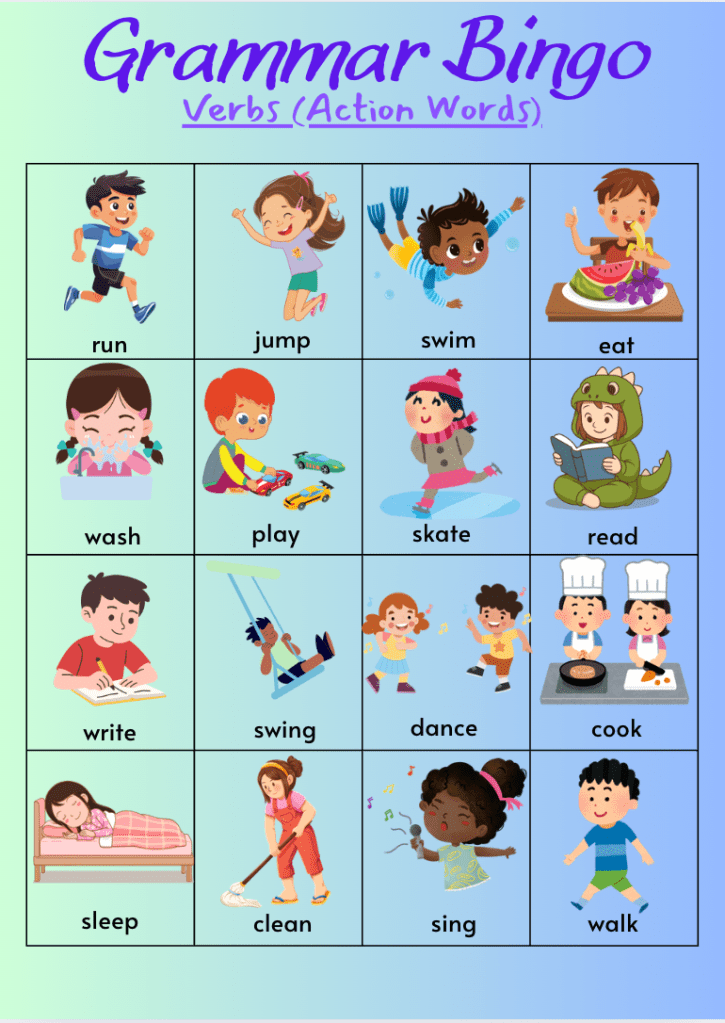
1. Grammar Bingo

Create bingo cards with grammar prompts such as nouns, verbs, adjectives, or past tense words. Call out examples, and kids mark the correct squares. This builds quick recognition of different parts of speech.

Example: Say “run.” Kids check if they have the word “verb” on their card.


2. Sentence Scramble

Write words from a sentence on separate cards and shuffle them. Kids must arrange them into a grammatically correct sentence. This strengthens sentence structure skills.

Tip: Start with simple sentences, then add more complex ones with conjunctions and adjectives.


3. Verb Charades

Kids act out verbs while others guess the word and say it in a sentence. This helps reinforce action verbs and proper usage.


4. Punctuation Relay

Write sentences without punctuation on slips of paper. Kids race to add the correct punctuation marks. This game makes punctuation practice fun and fast-paced.


5. Grammar Jeopardy

Create categories like “Past Tense Verbs,” “Adjectives,” or “Fix the Sentence.” Kids choose questions, earn points, and practice grammar through friendly competition.


6. Parts of Speech Scavenger Hunt

Hide words around the room. Assign each child a part of speech (noun, verb, adjective). They collect words that fit and then use them to build funny sentences together.


7. Board Game Twist

Take a simple board game like Snakes and Ladders. Each time a child lands on a square, ask them a grammar question. Correct answers let them move forward—making learning part of playtime.


Tips for Parents and Teachers

  • Keep games short and fun (10–15 minutes).
  • Adjust difficulty based on age and skill level.
  • Celebrate effort as much as correct answers.
  • Encourage kids to create their own grammar games for extra engagement.

Final Thoughts

When learning feels like play, kids are more eager to participate. By using these fun grammar games for kids, you can transform grammar from a challenge into a favourite activity. Whether at home or in the classroom, these engaging activities build strong English foundations while keeping children motivated and smiling.


The Benefits of Raising a Bilingual Child

In today’s world, speaking more than one language is a gift that opens doors in school, in future careers, and in life. For children, learning English alongside their home language gives them an incredible advantage that lasts well into adulthood. If you are raising your child to be bilingual, here are some of the benefits you are giving them:

1. Stronger Brain Development

Research shows that bilingual children develop stronger problem-solving, multitasking, and memory skills. Switching between languages exercises the brain like a workout, building cognitive flexibility and creativity.

2. Better Academic Opportunities

English is the global language of education, science, and technology. A child who can read, write, and communicate in English has more access to high-quality learning resources, international programs, and scholarships.

3. Future Career Advantages

In nearly every field, being bilingual is a huge advantage. Employers value people who can work across cultures and communicate with international clients. Speaking English can help your child stand out in a competitive job market.

4. Stronger Cultural Awareness

Being bilingual connects children with two worlds. They can enjoy books, movies, and music in both languages, and they grow up more understanding of other cultures. This builds empathy and open-mindedness — skills that are just as important as academic ones.

5. Closer Family and Community Connections

For many families, English is not the home language. Raising a bilingual child means they can communicate with family members in their first language while also being confident in English. This helps them feel connected both at home and in the wider world.

How Parents Can Help

  • Encourage your child to read and listen in both languages.
  • Make English fun through games, songs, and stories.
  • Celebrate your child’s progress, even small steps, and remind them of the gift they are building for their future.

Raising a bilingual child is an investment — not only in their education, but in their confidence, creativity, and future opportunities. The effort you put in today will reward them for a lifetime.

👉 If you’d like some practical strategies to support your child’s English learning, check out my last blog post for helpful tips parents can use at home.

English Tongue Twisters

Tongue twisters are a fun way to practice challenging pronunciation in English.  But don’t be hard on yourself if you find these difficult.  Many native speakers tend to get ‘tongue twisted’ when trying to say these quickly a few times.  In any case, they can help strengthen your pronunciation and are always good for a laugh!  Give these ones a try in good fun!

  • She sells seashells by the sea shore.
  • How much wood could a woodchuck chuck if a woodchuck could chuck wood?
  • Eleven benevolent elephants.
  • Lesser leather never weathered wetter weather better.
  • Fuzzy Wuzzy was a bear. Fuzzy Wuzzy had no hair.  Fuzzy Wuzzy wasn’t fuzzy.  Was he?
  • Peter Piper picked a peck of pickled peppers.
  • Which witch switched the Swiss wristwatches?
  • The great Greek grape growers grow great Greek grapes.

Let us know how it went in the comments section!  Don’t forget to like and share!

Advantages of Private Online English Lessons

If you are interested in English classes and are exploring the different options, it can certainly be overwhelming.  Some important things to keep in mind when choosing what type of classes are right for you are: why you want to learn English, how you tend to learn best, your own personal schedule and your personal goals.  To further help you out, in this blog we break down the specific advantages of private online English lessons. While there are many, here are a few of them.

  1. Suits any type of learner

Whether you learn visually, through audio cues or through practical work (maybe even a mixture of all three) private online classes will be able to suit your individual learning style.   Your teacher can work with you to provide a learning experience that works best for you.

2. Flexible and easy to schedule

Being online offers a lot of flexibility.  Lessons can easily be scheduled to fit a busy lifestyle and can be rescheduled if necessary unlike group classes.  You’ll also save tons of time not having to commute.  You can dedicate your extra time to your learning instead!

3. Lessons are planned to meet your specific goals.

In private classes, each lesson is planned specifically for you.  They are based on what you need and want to learn.  You can tell your teacher what you want to work on most and what your interests and goals are.

4. Work at your own pace

Just as lessons are tailored to your learning goals, they are also set at your own pace. You can choose to spend more time on a specific concept, rather than having to move so quickly on to the next as you would in a group class.  Your teacher will work with you to ensure you are moving at the right pace. Not too fast, not too slow…so that you can learn the concepts properly without lagging behind.

5. Converse with a native English speaker

Like in a regular class, you will still get to practice conversing in English. The only difference is that you’ll have the added benefit of conversing with a native speaker, your teacher!  This is an advantage as you can emulate your teacher’s speech rather than that of a fellow student who is also still learning.  Your teacher will also be better able to help you correct and improve your English on the spot!

We hope this was helpful! Let us know in the comments and don’t forget to like and share!

Common English Idioms (and what they mean)

Photo by Natalie Birdy on Pexels.com

Have you ever heard a phrase you couldn’t understand the meaning of?  You likely heard an idiomatic expression.  Idioms and idiomatic expressions are used in every language.  They add character to the language and help to convey more distinct meaning. However, due to their figurative nature, it can be difficult for a non-native English speaker, or someone who is just learning, to even begin to guess what they mean.  It’s just a matter of being familiar with them.  To help you out, here is a list of a few of the most common English idioms.  Some can be used on their own, while others are used as part of a sentence.  How many have you heard before?

1.Go bananas – go crazy 

When he realized he had won the lottery, he went bananas

2. Get into hot water – get into trouble

     Be careful not to get yourself into hot water.

3. Raining cats and dogs – pouring

    I wanted to take a walk, but it’s raining cats and dogs.

4. At the eleventh hour – at the last minute

    She changed her mind at the eleventh hour. 

5. Break a leg – good luck

    Break a leg! 

6. Bring home the bacon – bring home the money/ provide for a family.

Someone’s got to bring home the bacon in this household.

7. Once in a blue moon – once in a while, not very often

They only visit once in a blue moon.

8. Piece of cake/a walk in the park/ a breeze – easy or simple

That was a piece of cake./ That was a walk in the park./ That was a breeze.

9. Pulling my leg – teasing

Quit pulling my leg!

10. See eye to eye – agree, share the same perspective

    We always see eye to eye./ We never see eye to eye.

11. The bottom line – the important thing

    If we are late, we’ll miss the train. That’s the bottom line.

12. The whole nine yards – everything

    They really went the whole nine yards for that wedding.

13. At the end of the day – after much has been said and done

    At the end of the day, family comes first.

14. The cat is out of the bag – the secret is out, made public

    The cat is out of the bag now. 

15. Let the cat out of the bag/Spill the beans/ Spill the tea –   to reveal a secret

   She let the cat out of the bag./ She spilled the beans./ She spilled the tea.

16. Cut some slack – not be too critical

    I’ve been working all night. Cut me some slack!

17. Hit the hay/ hit the sack – go to bed

    I’m going to hit the hay./  I’m going to hit the sack. 

18. Call it a day – be finished working  

    After I finish this, I’m going to call it a day. 

19. Get bent out of shape – to get upset

    Don’t get yourself all bent out of shape.

20. Wrap my head around it – try to make sense of something.

    I can’t seem to wrap my head around it. 

5 Ways Improve English Fluency

Are you looking to improve your fluency in English? Here are some tips to help you out!

The images above are presented in a Jetpack Slideshow block, with a Fade transition effect.

  1. Watch movies in English
Photo by Pixabay on Pexels.com

Watching movies in English might seem like an impossible task, but it is one of the best ways to help you improve your English! It is extremely helpful to hear English as it is spoken. You will hear phrases and expressions you might not hear when practicing in the traditional ways.  When watching movies, it is best to turn on subtitles in your own native language to help you understand.  You can rewind and re-listen to anything you like. 

2. Listen to English Songs

Photo by Breakingpic on Pexels.com

Similarly to movies, you can also listen to English songs.  You can look up lyrics on the internet and follow along.  If there are any words or phrases you don’t quite understand and can’t translate, you can write them down in a journal and ask you English teacher to help you. 

3. Read Books in English

Photo by Janko Ferlic on Pexels.com

This one definitely sounds like a daunting task!  But remember you can start off with a book you already know and enjoy to help with understanding.  As with watching movies and listening to music, you can record anything you’d like to understand better in a journal and try to look up the meaning or ask your English teacher to help you understand.  Doing this will help you get a better feel for how English is typically spoken and help you improve fluency and speak English like a natural!

4. Write a Journal in English

Photo by Jess Bailey Designs on Pexels.com

An English journal can be very useful to help you record and keep track of words and phrases you want to understand when listening or reading in English.  Another great way a journal can help you improve your fluency is to write in it a few days a week or daily if you can.  You can write a short account of your day or about anything else you like.  Don’t worry about making mistakes, your teacher can help you correct them and in time you will be able to notice and correct them yourself!

5. Immerse Yourself in English

Photo by Anastasiya Gepp on Pexels.com

Now this one might be tricky if you live in a non English speaking country.  If you are already doing the tips in 1 to 4 you are already pretty immersed in the language. However, if you can manage it, it’s always best to have conversations with other (especially native) English speakers. If you are taking lessons with an English teacher, you can have conversations with your teacher.  There are also great resources online, like English speaking groups on social media and on apps where you can join to have conversations with native English speakers.  You may even find groups within your community where you can practice conversing in English. Combining this with listening, reading and writing in English, as well as taking English lessons, will most definitely help you improve fluency!

Fun and Effective English Learning Tips for Kids Around the World

Learning English can open doors for children everywhere — from academic success to future career opportunities. But as a parent, you might wonder: How can I help my child learn English effectively, especially if I don’t speak it myself?

Here are practical strategies that work for children of all ages, whether your child is a beginner or looking to improve their fluency.

1. Make English a Part of Daily Life

English doesn’t have to be confined to the classroom. Small, consistent exposure can make a big difference. For example:

  • Label items around the house in English.
  • Play simple songs or nursery rhymes in English for younger children.
  • Encourage them to describe what they’re doing in English during daily activities.

Consistency is key — even 10–15 minutes a day can help build vocabulary and confidence.


2. Encourage Reading and Storytelling

Reading is a cornerstone of language learning.

  • Start with picture books for younger children, gradually moving to short chapter books.
  • Ask your child to summarize the story in English.
  • Storytelling helps improve grammar, sentence structure, and creative expression.

If your child enjoys digital content, there are plenty of child-friendly English e-books and interactive reading apps that make learning fun.


3. Make Learning Interactive and Fun

Children learn best when they’re engaged. Consider:

  • Simple games like “Simon Says” or “I Spy” in English.
  • Craft activities with English instructions or vocabulary cards.
  • Role-playing everyday situations, such as ordering food or shopping, using English phrases.

Fun, hands-on experiences make language memorable.


4. Use Technology Wisely

There are countless apps and online resources that teach English in an interactive way. Tips for parents:

  • Set aside short, regular sessions instead of long, irregular ones.
  • Choose programs with clear instructions and child-friendly interfaces.
  • Encourage your child to practice speaking, not just reading or listening.

5. Consider Online Tutoring

Personalized guidance from a tutor can accelerate learning, especially for children with specific goals. A tutor can:

  • Tailor lessons to your child’s age, interests, and level.
  • Focus on speaking, reading, and writing in a balanced way.
  • Provide structured practice and immediate feedback.

Even short 30–45 minute sessions once or twice a week can make a big difference in confidence and fluency.


Final Thoughts

Helping your child learn English doesn’t have to be overwhelming. With consistent exposure, interactive practice, and personalized support, children can develop strong language skills that will benefit them for years to come.

As a certified teacher with experience in tutoring children internationally, I specialize in creating lessons that are both engaging and effective. If you’d like to learn more about how I can help your child reach their English language goals, feel free to contact me for a trial lesson.